Showing posts with label Wine - Country: USA. Show all posts

Monday, August 19, 2013

Down Among the Long Island Vines

In my family, family comes first, just as it ought to. Blood is thicker than water, and even than wine. Yet I cannot help but notice: friends tend to give much better gifts than family. Gifts from both are thoughtful and loving, but they are still wholly distinct. There is what one wants to have, and then there is what other people want for one to have. Family and friends each are aware of both; yet they have different priorities. Family will get you what it thinks you need; friends do not waste birthdays on such things.

Having the blessed life that I do, I can count more than a few people as both family and friends. Most began as the former and soon became the latter; one family, in particular, began as the latter. I can still remember the first day I hung out with my best friend, Mike, back in the Little League days. "Hi, Camille!" I greeted his mother as I entered his home.

"Uh, excuse me, there, bud, you can call me Mrs. Kennedy," came the reply in a tone that was simultaneously stern enough to scare me and sweet enough to spoil me, a perfect combination that comes as naturally to this particular matriarch as cooking and hosting, and that I have yet to hear successfully replicated by anyone else on the planet. So "Mrs. Kennedy" it was, until one day about seven years later, when I walked in and greeted her, "Heya, Mrs. Kennedy."

She looked at me. "You know, I hate that you call me that."

"Uh, I, oh, but, I think, wasn't it your idea?"

"Yeah, I remember," she replied matter-of-factly. "I just hate that you call me that, that's all."

There are three centers of human knowledge: the mind, the heart, and the gut. The latter two did not need to be told twice that we were well past strangerhood and formalities; indeed, we had barely ever been there in the first place. But the mind, well, as usual it proved itself a little slow on the uptake. "Oh, well, okay, so what should I call you?"

"Uh, gee, I dunno," came the sarcasm, which, when rooted in southern Italy by way of Brooklyn, is affectionate by more than mere implication. "Mom." Her look had two layers. One was was saying, "Duh," the other, "I love you."

From then on, Mike's parents have been Mom and Dad, which he calls my parents as well. But of course, Mike and I had adopted each other as brothers long before then. Thankfully, he did not, during that whole process of becoming family, lose the friend's intuition for gift giving.

This past week was my birthday. Never mind how old I am; it is old enough for me to groan about it, but young enough that nobody else wants to hear about it. I have not only survived the past year, but also gained, during that time, the best companionship a man can have, that of a consummately lovable woman who loves me back. So I count it as a win, ignore the number, and carry on. But first, I have had to indulge those around me who have wished to mark the occasion with various fripperies. That has meant packing my wine rack, depleting spare space on my bookshelves, schlepping out to restaurants, grinding craft roasted coffee, consuming enough calories to fill a freshly baked pie, transacting input with the bank, expanding my wardrobe, snuffling scented candles, and sitting through an entire gosh darn day of luxury bus rides and free wine tastings at vineyards on Long Island's North Fork. Sheesh, the things I do to humor my loved ones.

Hampton Luxury Liner runs a wonderful service. I have no idea how Mike found it, but I am glad that he did. The tour covers three vineyards: Pindar and Duck Walk for an hour each, and then Baiting Hollow for a little over three hours. At each vineyard, each person is allotted between three and five complementary half-glass tastes of (almost) any wines. After that, time can be spent buying more to drink, lounging around a patio, shopping for things to bring home, and strolling among the vines - people took advantage primarily of the first two. The bus picked up my lovely lady and me (Mike and his fiance did not attend) in Nassau County at 9 in the morning and got us back by around 7 in the evening, making for a long day. Most people had gotten on the bus in the Boroughs. These were no idle afternoon time-killers; they were in it to hit the wines good and hard. Nobody became so inebriated as to fall ill or cause trouble, but short of that people tossed off limitations for the day.

The average age was around thirty, and everyone came as either a couple or a group of women, which is hardly a surprise given trends in the market lately. Those with a mind for marketing will not marvel at the fact that neither the tour nor the vineyards bother much about how lovely the rows of vines are, or how interesting the winemaking process is. In fact, quite as most of the clientele would have it, the tour does not bother about much of anything other than efficiently shuttling people in luxury from one tasting room to the next, where the vineyards concentrate on serving their selections of tasty spirits.

Pindar was first. We began with a couple of whites. The 2012 Riesling has a citric nose with tones of apple, while the palate is sort of the inverse: a sweet, crisp yellow apple with hints of citrus. The 2012 Chardonnay is curious on the nose, with notes of crisp pear, quince, and lychee. The palate is lighter, of pear. Both are alright. Next came the reds, beginning with the delightful Isabella NV. It has a rich, luscious nose of blackberry and redcurrant, and tasting notes of cherry and strawberry, shockingly lighter than the nose, though not in a bad way. In fact, from the whole trip, we brought back with us only four bottles: three whites for Mike (one from each vineyard) and an Isabella for me. We also had the 2009 Cabernet Franc, which, I am disappointed to report, is decent on the nose with dry notes of cherry and rhubarb (almost Tempranillo-like), but ranges somewhere between bitter and nondescript on the palate. Finally I tasted the Sweet Scarlett blend, which is alright: strawberry nose and light rhubarb on the palate. I almost opted instead for the Pythagoras blend (a review of which is The Nice Drinks In Life's first post), as it is a favorite Long Island red of mine, but I drink that often enough, and preferred to try new things. I will say this about Pindar: of all the wines we tasted that day, Pindar has the single worst, the Cabernet Franc; but is otherwise positively ahead of the rest.

After sipping wine, my majestic mate and I bought a couple of bottles and then took a stroll around the building. The place is just lovely, and the vines looked great. Unfortunately, the day was more hot than warm, and instead of subjecting the bottles to the heat, we chided ourselves for not waiting a little while longer to buy them, and then sat under the shade on the patio, enjoying all that there was to see. What a beautiful day it was!

It took a little while to coax a certain group of ladies into putting their glasses down and getting back onto the bus, but soon enough we got them settled, and off we went. Next came Duck Walk, which is owned by the same family as Pindar, and located right down the road. The tasting room, as you can see on the left, was absolutely packed. Well, actually, that is not quite right: the tasting room, which is open and spacious (and which, I noticed, has lovely art on the walls), was mostly free of crowds. But the bar in particular, well, that spot did not allow for any degree of easy access for a little while.

But we did get up to it soon enough, and began again with the whites. The 2012 Sauvignon Blanc has a grassy nose with crisp citrus; the palate is more mellow, almost tropical, with notes of citrus and white table grapes. It is a pleasant wine, and I note that it is not at all a carbon copy of the 2011 Sauvignon Blanc Cuvée Select by Duck Walk that I reviewed here back in May; it is independent, its own find. We also sipped the Southampton White blend, which is absolutely perfect for the Pinot Grigio lover: dry and light on the nose, with tones of grape, citrus, and perhaps a hint of sea air; and crisp on the palate with citrus and pear tastes, and plenty of terroir to go around. Having a sweet tooth, I personally find Pindar's 2011 Riesling to be the yummiest white of the afternoon; but by any objective merits, Duck Walk far and away has the best whites of the three places.

At this point my comely companion, being in infinitely numerous ways an infinitely better soul than the average person on this trip (and anywhere else), put down her glass, having found both her limit and the wherewithal to respect it. My soul, on the other hand, leaves a great deal to be desired, and in any event I am blessed with a hepatic tolerance that will not come back to bite me for at least another twenty or thirty birthday celebrations to come. So I proceeded with some reds. First was the Gatsby Red blend, whose aroma of cherries and pomegranate is somewhat sour - not in an obviously delicious way, but subtly quite attractive and beckoning. The taste is sweeter, and of red apple, and was served chilled. I immediately pictured myself and some companions lounging around outside on a hot day, in the mood for some wine, nothing serious, with taste buds preferring red but the rest of the mouth and body preferring white, and this Gatsby Red humoring all. (It is not a rosé, but it does drink like one.) I also went for the Windmill Red blend, which is alright: a Tempranillo-like nose of cherry, plum, and cedar, and a spicy plum palate. I noted that it comes off a bit young, though not terribly.

At this point began the only true downside of the trip: we got hungry. The bus had food in the back; I have no idea what it was, because we did not think to eat at first, and it was just about gone by end of the second stop. Each gift shop has chips and crackers, but they are expensive, and not good to eat without other types of food, as it will just increase hunger in short order. Better to let the metabolism stay at rest for a little while longer. But Duck Walk did have a food truck out back, just next to the vines. So, after taking some goofy pictures among the foliage (did you notice in the picture above that there are not actually any grapes in my hand to be pondering?) we split a small, mediocre, greasy grilled cheese sandwich. It turned out to be all that we would eat all trip.

After going back inside to purchase some Southampton White for Mike (we learned our lesson!), we were right on time to get back on the bus. It was a longer ride to Baiting Hollow, perhaps about a half hour or so. The driver said twenty minutes; maybe, because we were a little weary from the alcohol, heat, and growing hunger, it only seemed longer. But in any event, we arrived soon enough. Baiting Hollow is a little different than the other two. Whereas Pindar and Duck Walk have bona fide tasting rooms, with the merchandise and other things to buy off to one side, Baiting Hollow has a regular gift shop with a small tasting bar in the corner. However, aside from all that, it boasts the most outdoor space, and the most complete outdoor experience to go with it: patios, lawns, tents, a couple of tables whence more wine samples are served, scores of tables at which to sit, a couple of live bands, and horse stables. Yes, horse stables: Baiting Hollow is very active in horse rescuing, and they keep some of the lovely creatures at the winery. The horses are quite personable; one can, and may, go up to the fence, talk to them, pet them, and so on. It is a fantastic experience.

Except, of course, that in short order we were starving. At least I was. In fairness, there was the opportunity here to buy a real lunch. But, well... perhaps I am too persnickety for my own good, but I really think that a lobster roll with the size and apparent quality of a street vendor's hot dog, yet the price of an actual lobster, deserves to be turned down. You know what I mean? I probably should have sucked it up and picked one of the half-dozen similar items on the menu. But I simply could not justify it, and my divine date was content with a bottle of fruit juice. So I told myself that after eating, the previous evening, fully half of the pumpkin-pecan pie that she had baked for me (in my defense, it was not a full-sized pie, even before I got my hands on it), I deserved to go a little hungry, and forewent the food.

What I most certainly did not forego was the wine. I stopped to consider if I was feeling alright, and indeed I was. Besides, there was no driving to be done any time soon. So I had another four tastes, beginning as usual with whites. The 2011 Riesling is quite good, having a complex nose of pear, quince, and citrus; it is at once sharp and sweet. The palate is apple and tropical melon. Next, I asked which wine would be good for Pinot Grigio lovers, and was directed to the 2011 White Satin blend. I suppose it is as close to a Pinot Grigio as anything in their selection comes, but in truth it is more like a Sauvignon Blanc than any other varietal. It has an aroma of pear and kumquat, and a mellow, grassy tasting note of pears. As for the reds, maybe I should have tried a simple varietal, but I was intrigued by their two main blends, Mirage and Red Velvet. The 2010 Mirage has a nose of strawberry, redcurrant, the Portuguese ginja berry (Espinheira makes such a wonderful cordial out of that stuff!), and soy sauce; the palate tastes of creme de cassis and plum. The 2010 Red Velvet is sweeter and a bit more put together, but the notes on the nose and palate are exactly - I mean, one hundred percent - the same as those of the Mirage. I saw the staff get the bottles correct when I asked for each, so there was no mix up to explain things, and the overall quality is markedly better in the Red Velvet, which is the more expensive of the two. But the complete and utter similarity is astounding.

Afterwards, my pulchritudinous partner and I split the remaining time between the porch (the building is a converted house), the horses, and the grounds. At one point a staff member got onto one of the horses, rode it to where the tables and band were situated, and had it trot about in such a way as to make it appear to dance along with the music. It was all very well done, very clever. Less clever was the young lady who, wanting to pet the horse's nose, made a wrong turn somewhere and walked smack into the (unmoving) horse's rear, bouncing right off and finding herself entangled with some hedges. I am not sure if anybody then cut off her supply of wine; security did, though, respond by cutting off access to the animal.

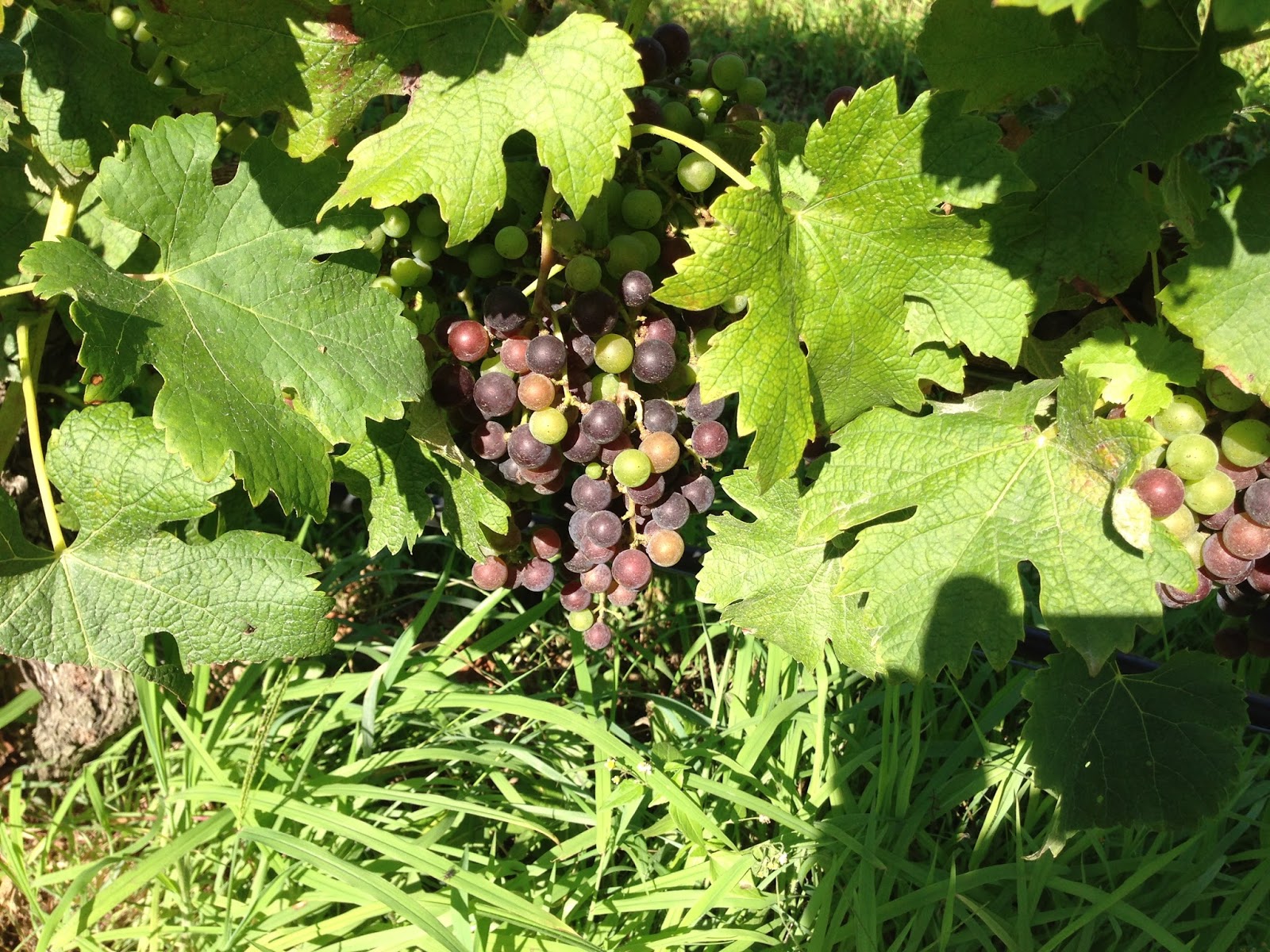
We also took a stroll through the vines. They were absolutely beautiful. I thought perhaps that we were sneaking around, but no: an employee saw us walking through the vines in a spot nowhere near the shop or patio, simply advised that we be careful, and left us alone. It was basically the same way in all three vineyards we visited, and probably countless others. Should I be worried that they were so completely open? The question struck me at first, but after considering the matter, I doubt that there is any cause for concern. It is not only that my seraphic sidekick and I ourselves resisted the temptation to pluck some grapes and munch on them (which, given our hunger, was not easy). It is also that nobody else was causing any trouble. In no place did we see guests messing with anything at all. Consider: at Baiting Hollow alone there were two full coach buses' worth of drunken, hedonistic yuppies hell-bent on throwing caution to the wind (our tour), four or five private limos, an equal number of larger luxury limo buses (one of which chauffeured a bachelorette party, an institution hardly renowned for its promotion of prudent forbearance), and a couple score individual cars carrying young couples, old couples, young children (I do not know why), and mingling singles. Even the six or seven perpetually unattended toddlers failed to lay a finger on so much as a single grape. Besides, the vineyards have all been doing this for decades at this point; if people needed to be kept out, they would be.

What a wonderful day it was! The weather was stunning, the bus ride was luxurious, the vineyards were gorgeous, the wines were delicious, my companion was an angel sent from heaven, and the whole thing took on an extra special air because it was a gift from a friend and a brother. Thank you Mike, and everyone else who has been so kind and generous this past week.

I recommend any of those wineries to people looking for a nice trip out East on the North Fork; or, even better, go get some tickets for the Hampton Luxury Liner and make a whole driving-less day of it. If only you remember to pack a sandwich and some snacks, you are practically guaranteed to enjoy. Cheers!

Thursday, May 30, 2013

Duck Walk 2011 Sauvignon Blanc Cuvée Select

Producer: Duck Walk Vineyards
Name: Sauvignon Blanc Cuvée Select
Varietal: Sauvignon Blanc
Region: Long Island, USA
Vintage: 2011
Tasted: May 13, 2013
ABV: 12.5%

How often have we heard Sauvignon Blanc described as "crisp"? Other adjectives are negotiable: Sauvignon Blanc may be sweet or dry; grassy or tropical; spunky or reserved; light or rich; mild or profound. To be sure, those dichotomies are legitimate, having to do with where the grapes are grown, how the wine is made, and no small dose of chance. But "crisp" - well, one who spends enough time in the wide world of wine will be excused if he comes to think that a picture of Sauvignon Blanc appears next to "crisp" in Merriam-Webster's. There is no escaping the phrase. Wine reviews, wine surveys, wine labels, wine advertisements - they all, without fail, are sure to explain just how crisp this or that Sauvignon Blanc really is. It is no less fundamental a description of the wine than "white".

But what do we mean by "crisp"? It is not easy to describe. As with any other adjective whose implication people take for granted from a very young age, to define it without resorting to mere lists of examples and roundabout categorizations is a most mischievously exacting task indeed. (If unsure what I mean here, try to define "red".) To simplify for the sake of convenience and brevity, I find that "crisp" generally refers to a distinct, even sharpness, or else the palpable potential thereof. This phenomenon is most commonly associated with the senses of sound and touch, such as with apples, paper, and autumnal air, but may certainly apply to any of the other senses as well, in this case taste via the olfactory nerves. (Most of what people taste in wine, coffee, and a hefty menu of other foods and drinks, are in fact sensed through the olfactory nerves, not the taste buds.)

The next question is, if a wine is to be called "crisp", what does that mean about the wine? Is it the flavors that are crisp? The texture? Does the liquid itself slice about the mouth? A Sauvignon Blanc may have any or all such aspects of crispness. The 2011 Cuvée Select by Duck Walk Vineyards on Long Island, New York, displays a smooth body, but a distinct sharpness of flavor that exemplifies what a Sauvignon Blanc is known to be.

Before it ever occurred to me to dissect the word "crisp" as above, I made the following note on this wine's color: "Clear, crisp, medium goldenrod. A bubble or two, but otherwise smooth." The first aromas are of melon: sweet, smooth, and deep. After a few seconds, it opens up a little, and citrus appears, but in an easygoing sort of way. It is not acidic. The entire aroma, even the citrus, is rather tropical.

In the mouth it is quite different. Riding on a full body, the citrus is much more dominant here, with notes of lemon zest and quince. An emergent acidity gives the wine a spark on the tongue. The remaining melon flavor, and a new note of nectarine, are very subtle. The texture here is smooth, but the flavor - fruity, but not tart so much as tangy - is not. By no means spicy, it is just as strong as though it were. It is pungent, in a sharp sort of way. It is - crisp. The finish is of lemon zest and pears, and it, too, is strong and pungent.

After aerating for twenty minutes, the wine is mellowed out some. The aroma is still of tropical fruitiness. Disappeared from the nose, the citrus is still dominant in the mouth, though the melon and nectarine have grown in prominence. The flavor as a whole has smoothed out to match the texture. It is still strong, but not pungent; maybe "full". My notes say "swirls of fruit". The finish now has added to it some melon.

As anyone familiar with Sauvignon Blanc has likely discerned by now, this wine can pair with a wide variety of foods. Like many whites it is also good, if chilled a bit, for simply sipping in the sun now that the warm weather is upon us. You will probably sip it among friends or family, in a backyard or similarly intimate venue to relax as a group, all convened after an busy Sunday of brunch, errands, baseball, and crossword puzzles. As you start to realize that it is almost dinner time, someone will right away reach for the wine, and someone else will get the glasses as the bottle is opened. The first glass will be about halfway finished before somebody serves snacks, then barbecue. Then the sun will signal that it will be setting any hour now, and some dessert will be served, maybe a strawberry shortcake, or a melon carved into a funny shape. Be sure, as you sip the wine, enjoying its rich texture and complexity of fruits, to take a brief moment - a pause in the conversation, a shifting of seats as someone gets up, or, best yet, a momentary retreat from the gossip for just long enough to glance over to where the lower ridge of the big, red sun is shimmering and shaking and digging the hole in the horizon into which the entire orb is about to descend - to truly enjoy it.

Thursday, October 11, 2012

Onabay Striper White


Producer: Onabay Vineyards
Name: Striper White
Varietals: Unknown
Region: Long Island, USA
Vintage: Unknown
Tasted: September 27, 2012
ABV: 12.5%

For just about my entire life people have said that I am what in Yiddish is called a kvetch, which is to say not just a complainer but a professional complainer, a complainer par excellence, a complainer's complainer. So maybe it is just that side of me coming out, but no matter how delicious Onabay's Striper White is (which is a lot), and no matter how versatile it can be (which is also a lot), I simply cannot get past the fact that they put neither a vintage year nor a varietal list on the label. Not even a year! This is wine, not fruit punch. Some things are just not acceptable.

What we do have, though, is a wonderful white wine to sip. The color is somewhere between pale gold and full straw. The nose is of white table grapes, citrus, and melon, more crisp than acidic. Actually, it almost approaches the nose of a red wine. The palate has a delightful fruitiness to it, like a fusion of tropical berry and tropical citrus. There is the very slightest bit of oakiness around the edges. The acid is there, but it feels very smooth, not acidic at all. One feels a slight bite right on the tip of the tongue - this is alcohol, after all - but mostly it is nice, relaxed, and sweet, reminiscent of lazy tropical days. The finish is of melon and apples. After breathing for twenty minutes, it does not change very much at all.

While Striper White's flavor implies balmy beach bumming, it would actually pair well with a variety not only of foods (chicken or seafood grilled with citrus, or with a tropical marinade like mango or papaya), but of scenes as well. I would be equally comfortable sipping this wine at a hot poolside barbecue or on a boat out on the sound on a cool, breezy day. In fact, this white can easily carry from the summer right through the fall.

But for goodness's sake, put a year on the label!

Tuesday, September 11, 2012

Moobuzz 2011 Pinot Noir

Producer: The Other Guys
Name: Moobuzz Pinot Noir
Varietals: Pinot Noir 86%; Sangiovese 10%; Syrah 1%; Tempranillo 3%
Region: California, USA
Vintage: 2011
Tasted: September 8, 2012
ABV: 13.5%

Did you know that when it comes to the use of sensual terminology in wine reviews - you know, that sometimes sappy, sometimes wildly inappropriate vocabulary that wine people use and that non-wine people make fun of wine people for using - Pinot Noir is the varietal most frequently being described? I did not know that until after I finished taking notes on the Moobuzz 2011 Pinot Noir by The Other Guys, as I browsed The Wine Bible by Karen MacNeil. Indeed, if my own reaction to the Moobuzz is any indication, that little tidbit of trivia sure does make sense.

For example, here is what I had written when trying to sort out how the acid in the taste does not have the usual concomitant bite or harshness along with it: "It is like a very beautiful person you see lying on the beach; she looks like an intense, wild-and-crazy sort of person, but really she is just lying there, taking it easy, looking hotter than all Hades." (Sometimes I write these things down as they come to me, lest I forget them later.)

So yeah, I really did not need much convincing from Ms. MacNeil on that one.

The 2011 Moobuzz Pinot Noir has a dark, ruby red color, quite seductive in itself. The aroma is intense, predominantly spicy with some red-fruity notes scattered about. The flavor, though, is smooth, even, mellow. While the tasting notes are of acidic things - citrus, mainly, and apples - there is no actual acidity to bombard the tongue. Again, think of the comely sun-bather: all the spunk and pizazz and craziness that the imagination pleases, none of the bother of having to deal with what all of that would actually entail. The texture is round, full-bodied, easy to enjoy. The finish is blackberry.

But a beach-goer who in fact just lies there all day would not be very much fun at all, now, would she? No, and our Pinot Noir has no interest in such doldrums. After aerating for twenty minutes, she has caught her breath and is ready for some action. The nose is as pungent as ever, and more fruits seem to have joined the party - it really is quite the medley. The palate is still smooth but less mellow. Some of the spice from the aroma has trickled on down to the mouth now, and the acidity is starting to feel like what one would expect from a bite of fresh fruit. For those who do not like fluctuating extremes there is good news: the wine, in her texture, remains as tender to the touch as ever, providing a nice level of balance, of sanity - we can feel comfortable enjoying the developments because the world still makes sense. And what kind of person would our Pinot Noir be if she left without dropping us a sweet surprise on her way out? The finish is strawberry, and ne'er could even the most alluring young lass so entice with a wink and a smile and a delicate wave as she slips past the threshold.

Here's to next time; soon may it come.

Friday, August 24, 2012

The White Knight 2010 California Moscato


Producer: The Other Guys
Name: The White Knight California Moscato
Varietals: Muscat of Alexandria 50%; Muscat Canelli 27%; Orange Muscat 3%; Pinot Grigio 20%
Region: Napa, California, USA
Vintage: 2010
Tasted: August 23, 2012
ABV: 11.5%

It is not every day that a proud New Yorker waxes poetic about the West Coast, but as my beloved readers have surely figured out by now, I will take any excuse. Of course, after tasting this wine by The Other Guys, the words flow much more easily.

Ah, California. It sort of has everything, doesn't it? Major metropolises, sprawling suburbs, gigantic farms, and acre after acre of pristine nature. Mountains, valleys, and flatlands; oceans, lakes, and desert. Naturally, this diversity extends to the lifestyles as well, and to dine in California can involve just about any dish, of any food, prepared any style, from any origin, traditional or cutting-edge, served in any setting.

But it will definitely include wine.

California has been making wine ever since the friars first ventured north from Mexico so many centuries ago. Wine is in the land there, in the air, the culture, the people's blood. The one state produces about ninety percent of the wine in the entire United States. If California were its own country, it would be the fourth-largest wine-producing nation in the world. It is emblematic of New World viticulture, and rightly so. And what could be more symbolic of the entire enterprise of California wine-making today than a nice bottle of something from Napa Valley?

Well, actually, Napa accounts for only four percent of wine made in California. But - bother the details! - it is still the most famous region in the state. And, sipping the White Knight California Moscato goes a long way to explaining why. The wine is a very pale, straw yellow, almost clear at certain angles. Its nose quite exemplifies that sweet scent for which we love Muscat. It is citric but not acidic, namely orange in this case. The palate, too, is mostly orange, but also includes some passionfruit and other tropical fruits. The wine is full-bodied; there is a small bite right as it first hits the tip of the tongue, which is the Pinot Grigio saying hello, and then it is all smooth from there. During the finish the wine starts to approach other fruit flavors. It is almost like swallowing one of those pink Starburst candies.

After breathing for twenty minutes, the wine becomes slightly altered, but is still mostly orange and very smooth. The nose acquires a hint of watermelon scent. The sipping notes are still very sweet, but the tropical flavors have left, leaving the taste more citric and a little more tart. The finish is diminished, but there are still some notes of fresh citrus, apple, and pear lurking about.

So maybe next time The Other Guys can use fifteen percent Pinot Grigio instead of twenty. Anyone not looking for such trivia will not even notice, and it is all a matter of taste anyway. The bottom line is, this sweet Muscat is absolutely delicious. Sip it lakeside in the sun; sip it where the rivers run. Sip it on a farm with hay; sip it brunching by the Bay. Sip it on a mountain summit; sip it on the beach and bum it. Sip it over in the Valley; heck, sip it anywhere in Cali. Or anywhere else, for that matter. One can hardly go wrong.

Monday, August 20, 2012

A Visit to La Chiripada Winery


The Spanish word chiripa means "stroke of luck." In the traditional dialect of northern New Mexico, the word is rendered chiripada. Some folks came to possess a patch of land in Dixon, NM, in the late 1970s, and decided to plant grape vines. Then they made wine one year. Not up to snuff. They tried again the following year. ¡Chiripada!

The vineyards and winery have been owned and operated by that same family ever since.

I visited La Chiripada in Dixon to remind myself what it is about New Mexican wine that is uniquely intriguing. The answer lies in the land: simultaneously sweet and spicy, rugged at first but friendly before very long, proudly standing up on its own but rich in rewards for those who taste of it. This holds true whether in reference to harvesting any of the scores of fruits, vegetables, herbs, and spices that grow in great abundance all over the region, or trekking among the most scenic hills and valleys that the country has to offer. This terroir does indeed make its wine, and we can be very grateful for it.


Producer: La Chiripada

Name: Special Reserve Riesling
Varietal: Riesling
Region: New Mexico, USA
Vintage: 2011
Tasted: August 17, 2012
ABV: 11.5%

The staff is very welcoming and the tasting room is a lovely atmosphere to both sip and chat about wine. The first wine that I tried was the 2011 Special Reserve Riesling, an estate wine. The aroma is sweet, fruity. It is acidic without being citric; when sniffing it, I imagined biting into a green fruit such as an apple. The palate does include citrus, though, and a few floral notes as well. It is sweet, and just a tad on the thick side. The finish is a delightful surprise, with notes of nectarine, papaya, and mango. All-in-all, it is quite as a Riesling should be.

Producer: La Chiripada
Name: Primavera
Varietals: Muscat 50%; Seyval Blanc 50%
Region: New Mexico, USA
Vintage: 2010
Tasted: August 17, 2012
ABV: 12%

Next up was the 2010 Primavera. I am told that the Seyval Blanc is a hybrid of Sauvignon Blanc and a strain of Vitis labrusca. The inclusion of a New World variety was intriguing and, it turns out, a keen idea. The Primavera offers a jumpy, lively nose with a full bouquet of flowers and some slight citrus notes around the edges. When sipping it, the mouth finds itself awash in nice, smooth orange blossom, with everything going down easy. The finish is its own elaborate production: the tasting notes take a step back, and then another, and then another, and soon, conspicuously but quite suavely, they have disappeared completely, leaving the taster quite ready to replenish his taste buds’ supply of the good stuff.


Producer: La Chiripada

Name: Río Embudo Red
Varietals: Cabernet Sauvignon 10%; Leon Millot 80%; Pinot Noir 10%
Region: New Mexico, USA
Vintage: 2010
Tasted: August 17, 2012
ABV: 13%

With two whites down, I was ready for some red. The 2010 Río Embudo Red, an estate wine, appropriately named for the river running through La Chiripada’s backyard, is billed as a perfect complement to Moroccan-spiced lamb. And is it ever! One can forgive the nose for thinking that a thousand tiny arrows of spice have been launched right at it from the glass. This can be a shock, but never mind, the glass's quiver empties out soon enough, and the nose finishes off with floral tones and a touch of fruit.

It is in this Río Embudo Red that the terroir resonates most. Notes of pine surround flush hints of the local flora: combinations of leaves and flowers, fruit and bark, herbs and spices, all fresh and sweet and harmoniously arranged together in an amazing expression of just how pure and beautiful and rich in earthly delights Dixon really is. The spice and sweetness coexist in a friendly balance, and though a tad dry, the wine is plenty smooth. It tries to specify a couple of particular flavors, rhubarb and hibiscus, for itself in the finish, but not before one has romped about in the hills and valleys of the Río Embudo and tasted of all that they have to offer.


Producer: La Chiripada

Name: Vintners' Reserve Red
Varietals: Ruby Cabernet 37%; Tempranillo 63%
Region: New Mexico, USA
Vintage: 2009
Tasted: August 17, 2012
ABV: 13%

After my mouth had a chance to descend back to ground level, it was recommended that I try the Vinters' Reserve Red. My kind readers may be wondering how I could fairly assess the merits of another red after being blown away by a different wine shortly prior. I myself was wondering just how the Reserve would perform. Excellently, it turns out. The Ruby Cabernet, a hybrid of Cabernet Sauvignon and Carignan, provides some clutch structure and depth, but the Tempranillo really shines through in the best way. The aroma is a refreshing blend of various red fruits and berries with blackberry in the forefront. The sweetness hits at the perfect angle. When sipped, the wine goes to work on the palate in the same way, full of delicious red everything. Strawberry has center stage now, and the wine is just an iota drier than when it was sniffed. Quite wonderful. Then, for the finish, the same notes briefly feint a linger before suddenly disappearing without a trace. Confound it, where did that flavor go? I want it back! Better have another sip… Ahh.

These La Chiripada wines certainly do have a way of including a dramatic flair on their way out.

At this point I took a tour of the winery. Josh Johnson, a second generation member of the La Chiripada family, was kind enough to show me around and answer some questions. They were only about a week into the harvest and had just begun the winemaking process that day. As a bladder press crushed some Chenin Blanc, it occurred to me that winemaking has none of the romance and double the coolness that everyone thinks. "See, most of these grapes won't be ready for harvest for another month or so," said Josh as he took a breather from washing tubs and pushing them onto a platform. "Actually, well, we've had a sort of drier season this year." He motioned toward the field of vines, which stretched from five yards in front of us to a point where, to the eye at least, they meld with the Río Embudo. "Maybe they'll be ready a little sooner."


Producer: La Chiripada

Name: Cañoncito Red
Varietals: Leon Millot 90%; Nebbiolo 10%
Region: New Mexico, USA
Vintage: 2011
Tasted: August 17, 2012
ABV: 13%

I returned inside to taste one more red before departing. This was unplanned, but I saw that the Cañoncito Red, an estate wine, includes Nebbiolo, and there was no resisting the urge to see how that grape fares on this side of the Pond. The 2011 opens with an enticing aroma of tart fruit. It was served chilled, and the nose combined with the refreshing coolness made me think right away of lounging outdoors on a hot day, eating a bowl of chilled apple and citrus slices, and sipping this wine. The palate is sweeter, and the texture smooth and thick. It has a long finish, which is also appropriate for lounging on a lazy summer day. The Leon Millot, another hybrid of European and American species, is a bit dominant due to the percentages. But the Nebbiolo really rounds it out great, and I was very glad to have tasted it.

The foothills of northern New Mexico have a great deal to offer. What with all of the museums, historical sites, shopping, culture, dining, music, dancing, walking, hiking, skiing, swimming, rowing, fishing, cycling, etc. to be done in the legendary expanse from Albuquerque to Santa Fe to Taos and beyond, not everyone will find it important to stroll into a small town with barely a handful of paved roads and a couple of thousand locals, just to see if those particular hills happen to have anything special to offer that cannot be found elsewhere. That is a shame, because they do. The land of Dixon, though close kin to the larger Río Grande valley, is a splendor all its own. Fortunately, even those who do bypass the Turnoff on their way between Santa Fe and Taos can sip wine from La Chiripada. It will bring them to the real thing in spirit, if not eventually in person.

Sunday, July 22, 2012

Pythagoras by Pindar


Producer: Pindar
Name: Pythagoras
Varietals: Cabernet Franc; Cabernet Sauvignon; Malbec; Merlot; Petit Verdot
Region: Long Island, USA
Vintage: Unknown
Tasted: July 22, 2012
ABV: 12.5%

This is my first review, and I would like to take the occasion to honor a red wine from my native Long Island. So, first, a disclaimer about that: I am a Long Islander through and through, proud of the place in which I was born, was raised, and have lived all my life (with an interlude for college) to the point, occasionally, of parody. However, that oikophilia does not extend to the realm of blind cheerleading. I have no qualms about noting a poor wine by an LI winemaker, even if it means making my hometown appear inferior to other wine regions, for the sake of honesty, for the sake of wine, and perhaps in the hope of encouraging my paesani to do better (in that order).

That said, I recently tried the Pythagoras blend from Pindar Vineyards, and was very pleasantly surprised. I bought it on a whim of equal parts adventure and parsimony, not expecting much from these varietals, which I normally do not prefer. (Give me a tempranillo, maybe blended with garnacha, or a sangiovese, any time.) Pythagoras is precisely the type of wine that I would normally pass over in favor of a Rioja reserva or Chianti classico without a second thought. However, it really comes through quite wonderfully. It bills itself as red table wine, but I do not hesitate to place it a couple of notches above that.

Pythagoras opens with a nose as though someone soaked a tiny piece of sandalwood completely through with a pungent, fruity raspberry vinaigrette, crushed it all into a fine powder, and used that powder to coat a small almond. It has a color just slightly more scarlet than blood red. At first sip, one can taste in Pythagoras notes of vanilla extract, and somewhat stronger notes of roasted chocolate braised with berry jam. The body was a medium body, with a slight sense of smooth “puffiness” that just might be a hint of butteriness. Those first sips finished with notes of crème de cassis.

After twenty minutes of breathing, not too much changed. Indeed, usually a wine needs to breathe a while to get to the point of smoothness at which Pythagoras was right away when opened – and from which it did not weaken over the course of the evening. The nose did take on a slight note of cherry/currant/strawberry, and lose the almond, after that time, and the finish was a little spicier with just a touch of rhubarb. But the taste and the body – and the sense of refreshing deliciousness – was quite the same throughout.

I do have some qualms with Pythagoras – or rather, as it were, with Pindar. The bottle says that this blend celebrates the vineyard’s fifteenth anniversary of winemaking, but their website says that it celebrates the twentieth. That means that even if I were inclined to do some research and then some math (right away, nope) just to figure out the vintage of the darn thing, inasmuch as it is not marked on the bottle, I am denied that option. And, while Pindar does list the varietals used in the blend, it does not mention in what percentages. Perhaps an experienced sommelier could taste the wine and amuse himself by taking an educated guess (full disclosure: I look forward to the day when I can do precisely that), but most of the world would rather know what it is getting into before taking on the financial and opportunity costs of acquiring the bottle.

Fortunately, I can assure said world that my beloved Long Island, and Pindar specifically, has produced in Pythagoras a wine worth much more than a retailer will charge for it, which is not very much at all. My notes from tasting it say it all: "Inexpensive, LI, no vintage, no percentage breakdown of the varietals, I don't usually like those varietals – and yet this wine is excellent." Get yourself a bottle today, and enjoy.